




Cart is empty. Please go to your home page for listing it.


In 1975, RSCN began fencing areas within Shaumari in preparation
for the first wildlife protection reserve in Jordan, covering an area
of 21 km2. Shaumari Reserve acted as the first model reserve in
Jordan’s dry desert climate, providing grounds for learning practical
application methods in establishing and managing other reserves around Jordan.
It is comprised of two main topographic features, desert wadis and hammada
areas. Desert wadis form around 60% of its total area, the most well-known
being Wadi Shaumari, which cuts straight through the heart of the site, giving
the reserve its name. Hammada areas occupy the remaining 35%, covering the area
with a layer of black flint. Shaumari provides an open location for Jordanian
Universities undergoing scientific research on arid and semi-arid areas.
Shaumari has been found to support highly varied biodiversity. So
far, more than 193 species of flora have been recorded at the reserve, the most
common species being Achillea fragrantissima, Artemisia sieberi, Atriplex
halimus, Matricaria aurea, Anabasis articulata, Retama raetam
and Peganum harmala. Six species of carnivores have been found to
inhabit the area, including the Red Fox (Vulpes velpes), Jackal (Canis
aureus), Wolf (Canis lupus), Striped Hyena (Hyaena hyaena),
Caracal (Caracal caracal), and Wild Cat, while bird sightings in the
reserve include Eastern Imperial Eagle, Pallid Harrier, Hoopoe Lark, Desert
Wheatear, and Egyptian Vulture.
Shaumari Wildlife Reserve was initially created as a breeding
center aiming to breed and reintroduce the globally threatened and locally
extinct wildlife and specifically the Arabian Oryx (Oryx leucoryx). In 1978,
joined by international efforts, RSCN initiated the Arabian Oryx rescue
operation after receiving 8 Oryx animals from the San Diego Zoo, USA, into
specially prepared breeding enclosures in Shaumari Reserve, in an attempt to
return the Arabian Oryx to its native desert habitat. By 1983, this operation
met its first success, after the release of 31 Arabian Oryx from captivity into
their native habitats within the reserve.
Shaumari Wildlife Reserve is now home to some of the rarest species
of animals in the Middle East, such as Ostriches, Gazelles, and Persian
Onagers. RSCN has exerted great effort to help these animals rebuild their
populations and reassert their presence within the safety of the reserve,
protected from the hunting and habitat destruction that nearly wiped them out.
Visitors to Shaumari have an opportunity to see the living results of this global co-operation. The Oryx can often be seen roaming freely in the desert grassland, and the Ostriches, Gazelles, and Onagers can be observed in their enclosures. As a model of environmental education that is suitable for all levels of learners, the reserve has become a popular spot for children and school outings


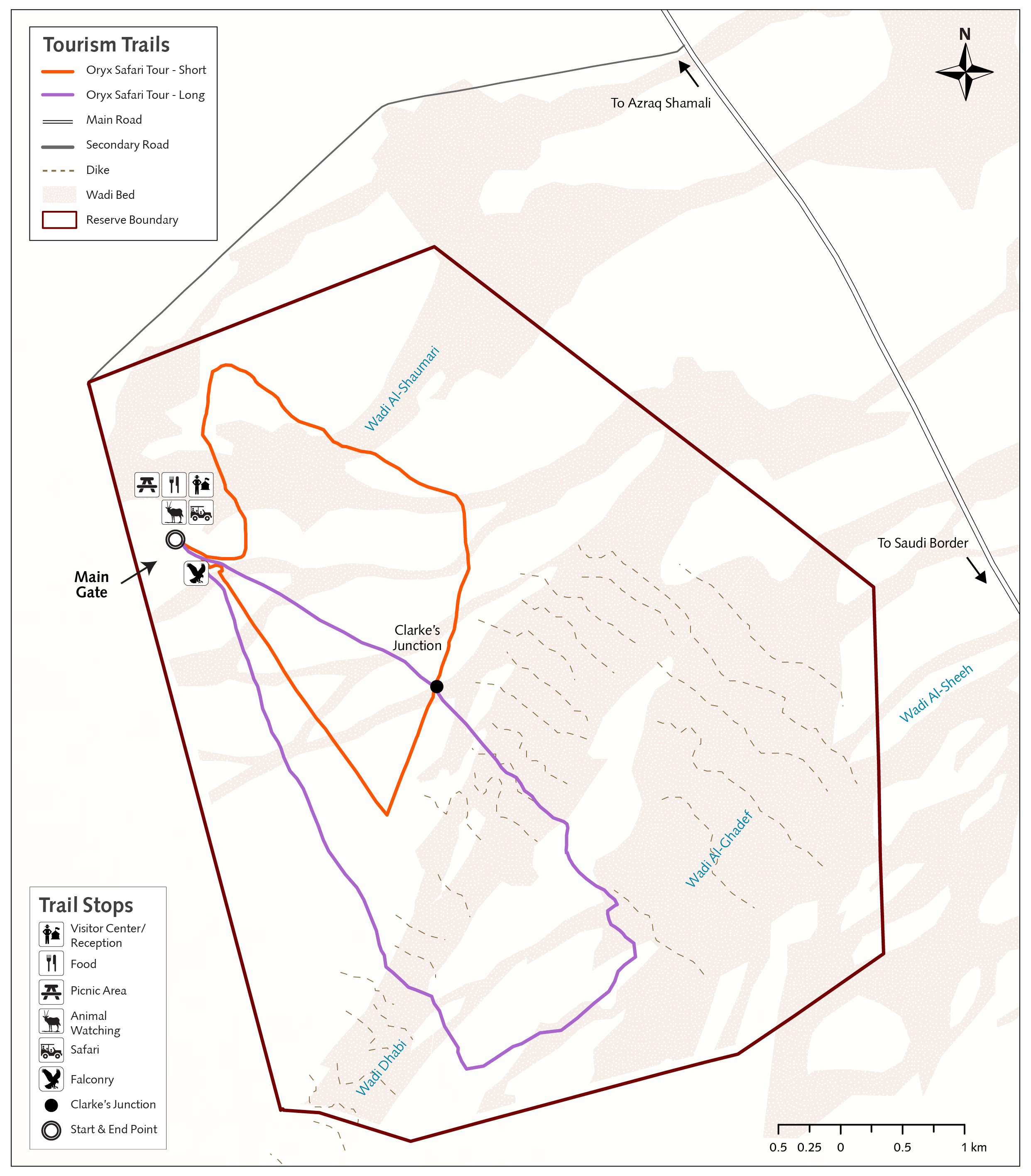 Shumari trails map