




Cart is empty. Please go to your home page for listing it.


Ajloun Forest Biosphere Reserve was established in 1987 to protect
a representative example of evergreen oak forests within the Mediterranean
biogeographical region. The reserve covers an area of approximately 8.5 km² and
is located in the northern highlands of Jordan. It is characterized by
mountainous terrain intersected by wadies, with elevations ranging between
approximately 900 and 1,050 meters above sea level.
The need to protect Ajloun forests emerged based on the findings of
ecological studies and field surveys that highlighted their high environmental
value. The reserve represents one of the most significant vegetation types in
northern Jordan, evergreen oak forests, which form part of the Mediterranean
ecosystem, known for its rich biodiversity. This emphasizes its critical role
at both the national and regional levels, especially considering that natural
forests make up less than 1% of Jordan's total land area.
The reserve is dominated by dense vegetation primarily composed of
evergreen oak trees (Quercus coccifera), accompanied by other tree
species such as Palestinian pistachio (Pistacia palaestina), and Greek
Strawberry Tree (Arbutus andrachne). It also supports a rich
ground-layer vegetation of shrubs and herbaceous plants characteristic of
Mediterranean ecosystems. Historically, these plant resources have been important
to local communities, serving as sources of fuel, food, and traditional
medicine.
Ajloun Forest Reserve is distinguished by its significant and rich
biodiversity, providing suitable habitats for a variety of forest-associated
fauna, including the stone marten (Martes foina) and the Persian
squirrel (Sciurus anomalus), in addition to species such as the red fox
(Vulpes vulpes), and the wild boar (Sus scrofa). The
reserve also supports rich plant diversity, with hundreds of recorded species,
including several of ecological and national conservation importance.
A wide range of wildflowers of significant ecological value are
found within the reserve, including the Purple Iris (Iris atropurpurea)
and Nazareth iris (Iris bismarckiana), various orchid species such as
Anatolian orchids (Orchis anatolica), and red tulips (Tulipa stylosa).
Some of these species are listed under international conservation agreements
such as CITES, further emphasizing the plant significance and importance of the
reserve at both national and regional levels.
In 2000, Ajloun Forest Biosphere Reserve was designated as an
Important Bird Area (IBA) in recognition of its role in supporting both
resident and migratory bird species. In 2025, it was further designated as a
Biosphere Reserve under the Man and the Biosphere (MAB) Program of United
Nations (UNESCO), reflecting international recognition of its ecological
significance and its role as a model for balancing biodiversity conservation,
sustainable development, and community engagement.
As part of species conservation efforts, the RSCN implemented a
reintroduction program for the Roe deer, which had become locally extinct due
to overhunting and habitat degradation. The program involved captive breeding
followed by gradual reintroduction of individuals within the reserve,
contributing to enhancing the presence of the species within its natural
habitats.
Despite its high ecological importance, the reserve faces several
challenges, including land ownership fragmentation within its boundaries,
leading to habitat fragmentation, as well as unregulated human activities such
as woodcutting, grazing, and hunting. Additionally, increasing tourism pressure
poses further threats to the sustainability of its ecosystems.
Nevertheless, Ajloun Forest Biosphere Reserve stands as a leading
model for protected area management in Jordan, where science-based management
plans are implemented alongside effective community outreach programs. These
efforts have significantly enhanced environmental awareness among local
communities, strengthened their participation in conservation, and supported
the development of eco-tourism and sustainable livelihood initiatives.


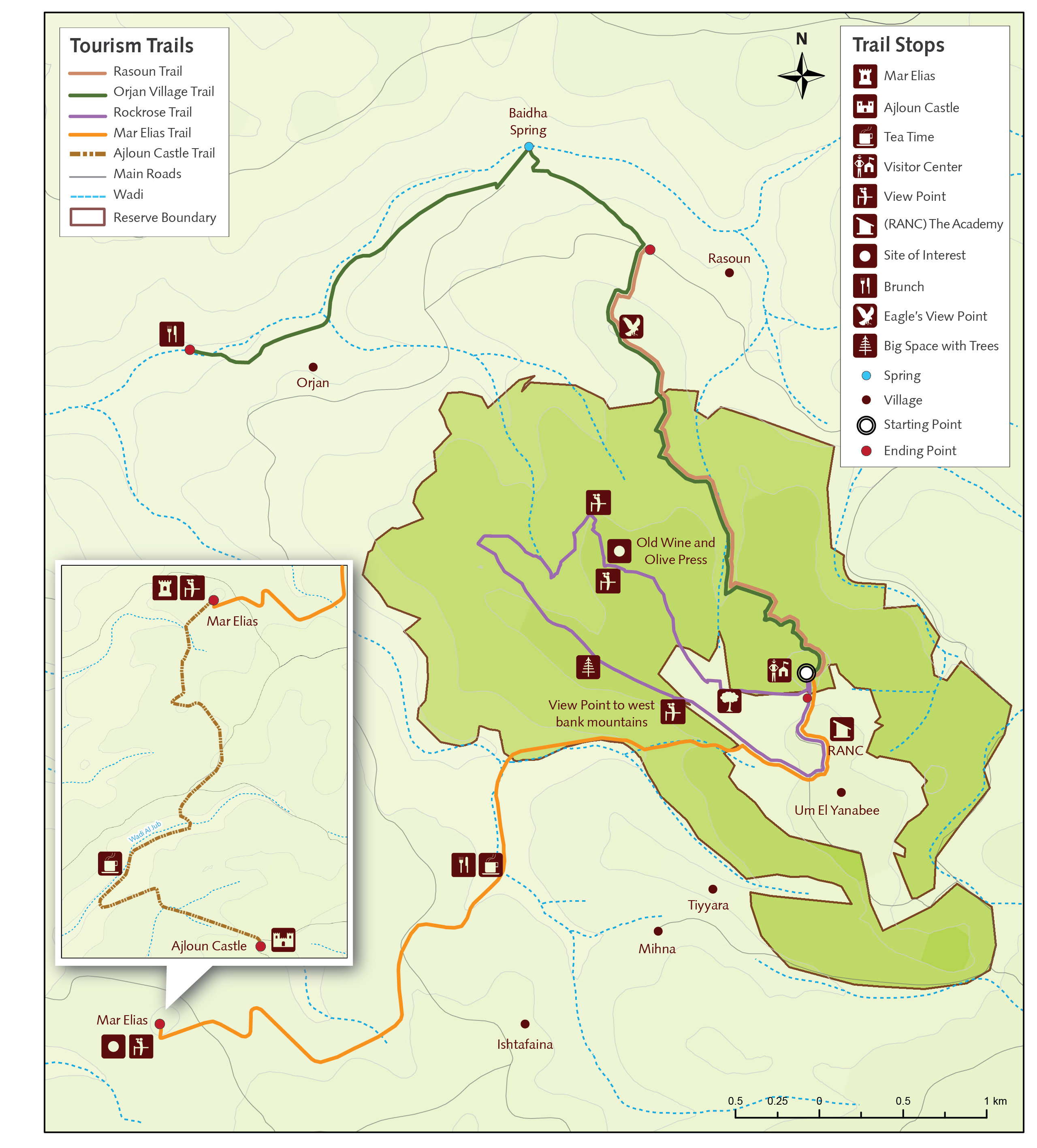 Ajloun trails map